Top Estate is one of Montenegro's most established property agencies, offering listings across the country's key residential and commercial markets — from coastal apartments in Budva and Tivat to mountain retreats near Kolašin and investment properties in Podgorica.
What Is Top Estate and Who Is It For?
Top Estate operates as a full-service real estate agency focused on Montenegro's residential and commercial property market. It serves both local buyers and the significant cross-border audience — European, Russian-speaking, and international investors — who are drawn to Montenegro's Adriatic coastline, competitive entry prices relative to Western Europe, and the country's ongoing EU accession trajectory.
Whether you are searching for a holiday apartment, a permanent residence, a rental-income villa, or a commercial unit, Top Estate positions itself as a one-stop point of contact: listings, legal coordination, and post-sale support.
What Types of Property Does Top Estate List?
The agency covers the full spectrum of Montenegro real estate:
- Residential apartments — studio to multi-bedroom units in coastal towns and the capital
- Villas and luxury houses — sea-view and hillside properties popular with lifestyle buyers
- Land plots — coastal, agricultural, and development land
- Commercial property — retail units, office space, hotels, and hospitality assets
- New-build developments — off-plan and recently completed projects from VAT-registered developers
This breadth matters because buyer needs differ sharply: a retiree relocating from Western Europe has different priorities than a developer acquiring land for a boutique hotel.
Where Does Top Estate Operate in Montenegro?
Coverage spans all of Montenegro's primary property corridors:
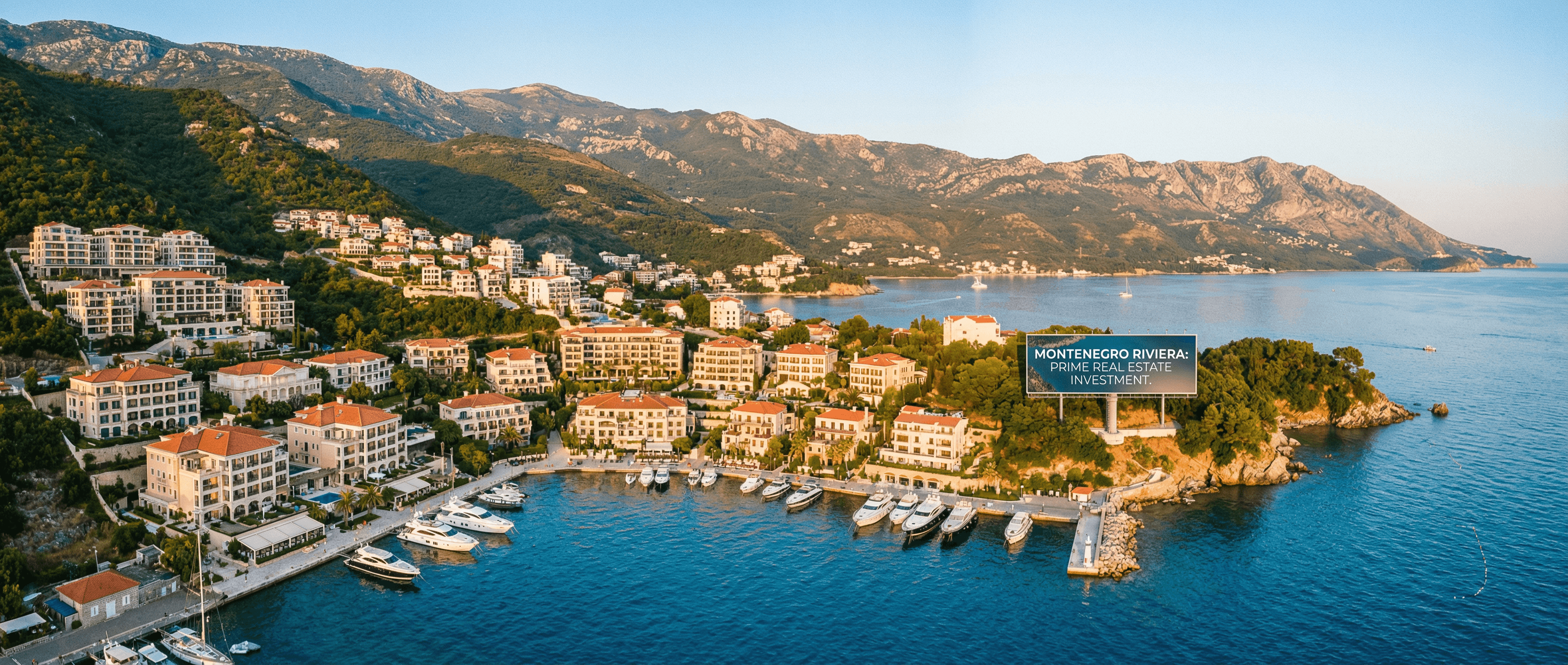
The Bay of Kotor (Boka) — Kotor, Tivat, Herceg Novi. This is the premium coastal belt, home to Porto Montenegro and a concentration of luxury marina-adjacent apartments. Demand here is driven by yachting lifestyle buyers and high-net-worth individuals.
The Budva Riviera — Budva, Bečići, Sveti Stefan, Petrovac. The highest-volume coastal market. Entry prices are lower than Boka Bay for comparable square footage, and rental yields from summer tourism are historically strong.
Podgorica — The capital offers the most liquid market for long-term rentals, commercial space, and practical buy-to-let investment. Price-per-square-metre is lower than the coast, but occupancy rates for residential rentals are year-round rather than seasonal.
Bar and Ulcinj — The southern coastal strip. Bar's position as a ferry and rail hub adds a logistics dimension; Ulcinj attracts buyers looking for earlier-cycle pricing in an area with significant tourism development plans.
Mountain areas (Kolašin, Žabljak) — A growing segment as ski tourism and eco-tourism infrastructure expands. Properties here suit buyers seeking an alternative to coastal crowds or diversified portfolio exposure.
How Does Buying Through a Montenegro Agency Work?
Understanding the process protects you — especially as a cross-border buyer unfamiliar with local procedure.
Step 1 — Property Search and Offer
Browsing listings is free. Once you identify a property, you submit an offer, which the agency communicates to the seller. Accepted offers are formalised in a preliminary agreement (predugovor), typically accompanied by a deposit — usually around ten percent of the agreed price, though this is negotiable and should be confirmed in writing for each transaction.
Step 2 — Due Diligence
A licensed local attorney should verify title at the cadastre (Uprava za nekretnine), confirm there are no encumbrances or planning disputes, and review the preliminary contract. This step is non-negotiable for international buyers. Reputable agencies facilitate attorney introductions, but the attorney works for you, not the agency.
Step 3 — Final Contract and Notarisation
The sale and purchase agreement (ugovor o kupoprodaji) is signed before a notary (javni bilježnik). The notary verifies identities, confirms the cadastre status, and registers the transaction. Foreign nationals can buy freehold property in Montenegro without restriction, with the same ownership rights as citizens.
Step 4 — Taxes and Fees
Montenegro's transfer tax applies on the secondary market only and follows a progressive structure: the rate rises with the assessed value of the property. New-build purchases from a VAT-registered developer attract VAT instead — the two taxes are mutually exclusive, never combined. Annual property tax is set by each municipality and expressed as a percentage of assessed value, with rates varying across the country's local governments.
Buyers should budget separately for notary fees, cadastre registration fees, and legal fees — these are typically modest in absolute terms but vary by transaction size and complexity.
What Should You Ask Top Estate Before Signing Anything?
Experienced buyers arrive with a short list of non-negotiable questions:
- Is the title clean? Ask for the current cadastre extract (list nepokretnosti) upfront.
- Is this a new-build or resale? This determines which tax regime applies.
- What is the legal build status? Confirm whether any structures have full use permits (upotrebna dozvola).
- Are there any liens or mortgages registered? The cadastre extract shows this, but ask explicitly.
- What are the agency's fees and who pays them? Commission structures vary; clarify before you spend time on a property.
How Does Top Estate Support International Buyers?
Cross-border buyers face language barriers, unfamiliar legal systems, and the logistical challenge of viewing property remotely. A serious Montenegro agency addresses this through multilingual service (English and Russian are standard across established agencies), remote-viewing video calls, virtual tours, and power-of-attorney arrangements that allow a trusted local representative to complete steps on your behalf.
Ask whether the agency can coordinate currency exchange (EUR is Montenegro's de facto currency, which eliminates foreign-exchange risk for eurozone buyers), tax registration for non-residents, and utility connection transfers — all practical steps that catch foreign buyers off-guard after a sale completes.
Is Montenegro Real Estate a Good Investment Right Now?
Montenegro's appeal rests on several structural factors:
- EU accession process — candidate status and ongoing accession chapters influence long-term institutional confidence among European buyers
- Tourism growth — visitor numbers have grown consistently, supporting short-term rental demand on the coast
- Relatively low entry costs — compared with neighbouring Croatia's Adriatic coast, Montenegro remains competitively priced per square metre in most markets
- No restriction on foreign ownership — buyers from any country can hold freehold title
The risks are equally structural: a relatively thin resale market in some locations, seasonal rental concentration, infrastructure gaps outside major towns, and a legal and planning environment that requires diligent due diligence. Treat any agency projection of yields or appreciation as indicative, not guaranteed, and verify assumptions with independent legal and financial advice.
Frequently Asked Questions
Can foreigners buy property through Top Estate in Montenegro?
Yes. Foreign nationals, regardless of citizenship, may purchase freehold property in Montenegro on equal legal terms with citizens. The process requires notarisation and cadastre registration. No special permits are needed for residential purchases.
What is the difference between buying a new-build and a resale in Montenegro?
New-build purchases from a VAT-registered developer are subject to VAT on the sale price. Resale (secondary market) purchases are subject to the transfer tax, which is calculated on a progressive scale based on assessed value. The two regimes are mutually exclusive — you will pay one or the other, not both.
Do I need a lawyer if I use an agency?
Yes. An agency represents the transaction; a lawyer represents your interests. For a cross-border buyer especially, independent legal review of title, the preliminary contract, and the final agreement is strongly advisable before any money changes hands.
Can I complete a purchase remotely without travelling to Montenegro?
In most cases, yes. A notarised power of attorney granted to a local representative — typically your attorney — allows the signing and registration steps to be completed on your behalf. Many buyers combine one viewing trip with remote completion.
What ongoing costs should I budget for after buying?
Annual property tax (set by the municipality as a percentage of assessed value), building maintenance fees if buying in a managed complex, utility connections, and — if renting out — potential income tax obligations. Consult a local accountant for current rates applicable to your specific situation.