Buying estate in Montenegro means acquiring freehold property in a country where foreign nationals can own land and buildings outright, with a transparent registration process and a progressive transfer-tax structure that applies to most resale purchases. Whether you are looking for a coastal apartment, a rural villa, a building plot, or a commercial premises, the steps — from search to title registration — follow a defined legal path that this guide walks through in full.
What Does "Estate" Mean in the Montenegro Property Market?
In Montenegro's legal and market context, "estate" (nekretnina) covers all categories of immovable property: apartments, houses, villas, land parcels, and commercial units. Foreigners and legal entities registered abroad have the same right to purchase as Montenegrin citizens, with one practical exception: agricultural land above a certain area threshold typically requires a locally incorporated company as the purchasing vehicle. For standard residential and commercial purchases, no special permit is required.
How Do You Find the Right Property?
Start With the Location, Not the Listing
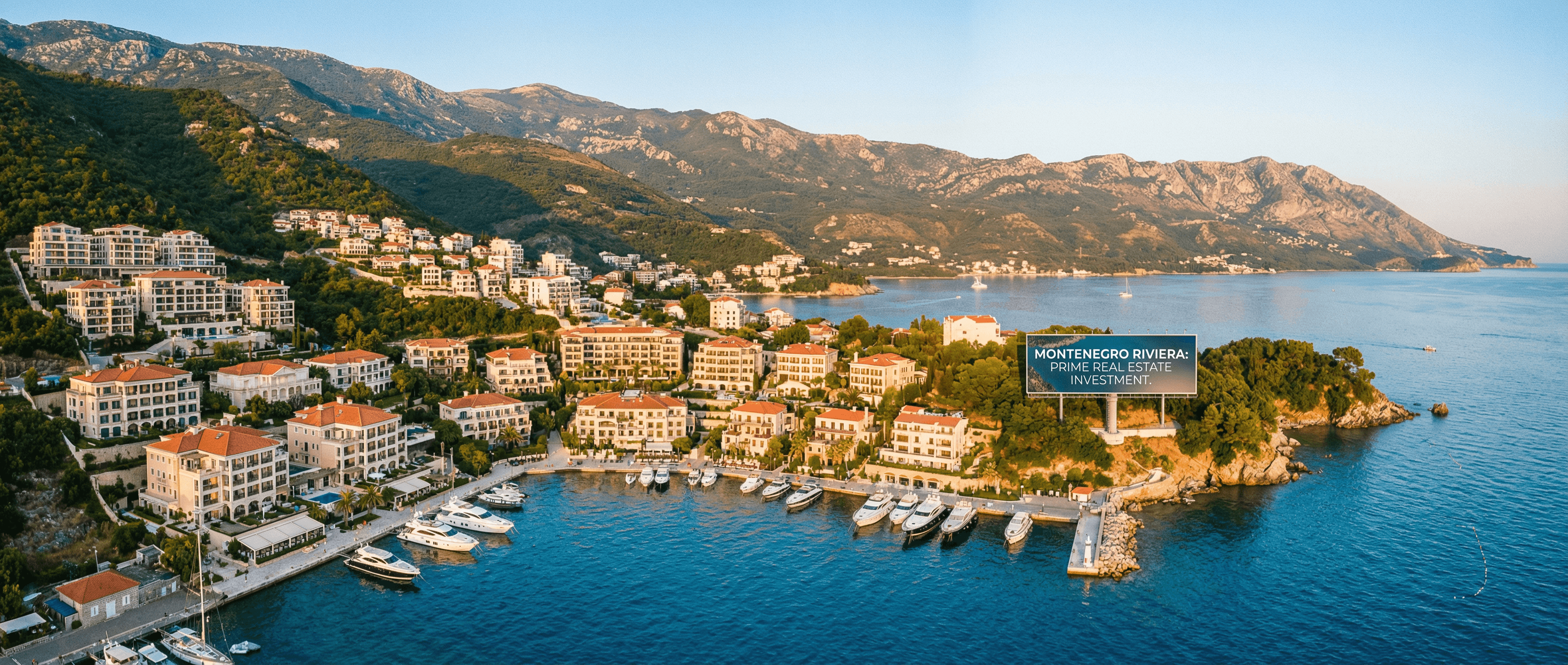
Montenegro is compact but geographically diverse. The Bay of Kotor and the Budva Riviera attract the highest demand — and command the highest prices — for sea-view residential property. Podgorica, the capital, is the primary market for long-term rental yields and commercial real estate. The northern mountain towns of Kolašin and Žabljak appeal to buyers seeking ski resort or eco-tourism investments, often at significantly lower entry prices.
Define your purpose first: owner-occupied lifestyle purchase, rental-income asset, capital-growth play, or a combination. That decision shapes which micro-market and property type makes sense.
Working With a Local Agency
A reputable registered agency adds value well beyond the listing itself — verifying ownership status in the Cadastre (State Real Estate Directorate), flagging encumbrances or mortgages, and coordinating with a notary. Fees and commission structures are negotiable and should be agreed in writing before you enter into any reservation.
What Are the Legal Steps to Buy Property in Montenegro?
Step 1 — Due Diligence on Title
Before signing anything, instruct a lawyer to run a Cadastre check. This confirms the seller is the registered owner, reveals any mortgages, liens, or third-party rights, and shows the property's legal classification (residential, agricultural, commercial). It also verifies that the building has a valid use permit — critical for newer constructions.
Step 2 — Preliminary Contract and Reservation
A preliminary contract (predugovor) locks in price, payment schedule, and conditions. It is typically accompanied by a deposit — commonly around ten per cent of the purchase price, though the exact figure is negotiated between parties. If the buyer withdraws without cause, the deposit is forfeit; if the seller withdraws, the buyer is generally entitled to double the deposit under Montenegrin contract law.
Step 3 — Notarised Sale Contract
The main sale-and-purchase agreement must be notarised to be legally valid and to trigger registration. Both parties (or their authorised representatives with a power of attorney) attend the signing. The notary verifies identity and capacity, and the document becomes the instrument for Cadastre registration.
Step 4 — Transfer Tax
For resale properties, the buyer pays a progressive transfer tax on the market value:
- Three per cent on the portion of value up to €150,000
- An increasing marginal rate applies on the portion between €150,000 and €500,000
- A higher marginal rate applies on the portion above €500,000
The buyer must self-assess and pay within fifteen days of signing the contract. For new-build properties sold by a VAT-registered developer, VAT at the standard rate applies instead of transfer tax — the two are never charged simultaneously. Budget for notary and agency fees in addition to the tax.
Step 5 — Cadastre Registration
Once the tax is settled, the lawyer files the transfer at the local Cadastre office. Registration formally vests title in the buyer's name and is the moment at which ownership is complete.
Can Foreigners Own Property and Get Residency?
Yes — foreign nationals can hold freehold title in their own name for residential, commercial, and most land purchases. Owning property in Montenegro does not automatically confer residency rights, but property ownership is one of the accepted grounds for applying for a temporary residence permit. Permit holders who maintain lawful, continuous residence can, over time, progress toward permanent residence. The residence rules have been revised in recent years, so current requirements should always be confirmed with an immigration lawyer at the time of application.
What Are the Ongoing Costs of Owning Montenegrin Estate?
Annual property tax is levied by the municipality and calculated on the assessed value. Rates vary by municipality and property category; they are generally modest compared with Western European equivalents but the exact percentage differs by location and use type. Utility connections, communal fees for apartments in managed buildings, and building insurance are the other routine costs. Rental income from the property is subject to Montenegrin personal or corporate income tax, depending on the ownership structure; professional tax advice is recommended before structuring a buy-to-let acquisition.
What Should You Watch for When Buying Off-Plan or New Build?
Developer Track Record and Permits
Verify that the developer holds a valid construction permit and that the land title is clean before paying any reservation deposit. Ask to see the architectural project as approved — changes made after permit issuance can create legal complications.
Payment Schedules and Bank Guarantees
Off-plan payments are typically staged across construction milestones. Where possible, negotiate a bank guarantee or escrow arrangement so that instalments are protected if the developer encounters financial difficulties.
Utility Connections and Use Permit
Completion of the building does not automatically mean utilities are connected or the use permit (upotrebna dozvola) has been issued. Make sure the contract specifies that the developer is responsible for obtaining the use permit before the final payment is due and title transferred.
Renting Out Your Montenegro Property: Key Points
Short-term holiday rental is a well-established income strategy on the coast and in ski resorts. Landlords must register the rental activity with the local tourism authority and Tax Administration. Long-term residential lettings are governed by the Law on Obligations; written lease agreements, clearly stating rent, term, deposit, and maintenance responsibilities, are strongly recommended. Both income streams carry Montenegrin tax obligations; a local accountant familiar with property rental will help structure this efficiently.
FAQ
Q: Can I buy property in Montenegro without visiting in person? A: Yes. You can grant a power of attorney — notarised locally or at a Montenegro consulate abroad — to a lawyer or agent, who then signs all documents on your behalf. Many international buyers complete purchases remotely, though a site visit before signing a preliminary contract is always advisable.
Q: Is it safe to buy property in Montenegro as a foreigner? A: Montenegro's legal framework gives foreigners equal property rights to citizens for most asset classes. The key protection is rigorous due diligence: Cadastre verification, a clean title, a proper notarised contract, and a competent local lawyer eliminate the overwhelming majority of risk.
Q: How long does the full purchase process take? A: A straightforward resale typically takes four to eight weeks from agreed price to Cadastre registration, assuming no title issues and prompt tax payment. New-build or off-plan timelines depend on construction progress.
Q: What currency are transactions conducted in? A: Montenegro uses the euro. All contracts and taxes are denominated in euros, making price transparency straightforward for EU-based buyers and simplifying currency planning for others.
Q: Do I need a Montenegrin bank account? A: You are not legally required to open a local account, but having one simplifies tax payments, utility billing, and rental income management. Most local banks offer accounts to non-residents subject to standard KYC documentation.
*This guide provides general information for educational purposes and does not constitute legal or tax advice. Always engage a qualified Montenegrin lawyer and, where relevant, a tax adviser before committing to any property transaction.*